
translate

Abbatia

Her Story

Roman replica of Greek Statue of the Fourth Century CE, from the New Wing Chiaromonte Museum of the Vatican Museums, Vatican City, Italy. Photo credit: Sailko
Roman replica of Greek Statue of the Fourth Century CE,
from the New Wing Chiaromonte Museum
of the Vatican Museums, Vatican City, Italy.
Photo credit: Sailko
The ancient Roman Goddess Fortuna has been a very well known and popular Goddess since at least 640 B.C.E.

The Goddess Fortuna has been an inspiration for women and children and a protectress for men, a provider of happiness and success in love, long-term relationships, career, and good health.

From Her ancient origins, She thrived throughout the Common Era and continues Her presence in contemporary culture.

As Rome expanded from a city to an empire throughout Italy, and into Europe, North Africa, the Middle East and Britain, so did Fortuna’s vast realm. She appears in architecture, artwork and inscriptions to the Goddess.

Many temples were dedicated to Goddess Fortuna in ancient times and she took on different roles depending on the type of assistance requested by the petitioner.

These roles are represented in names describing Her various aspects; many of which are found in ancient documents and inscriptions, and in the names of Her festivals.

The Roman festivals of the Goddess Fortuna, as they have been handed down through the ages, are shown on the Calendario (Calendar) page of this website.

The Goddess Fortuna also had regional celebrations. She was greatly honored as a protective Goddess at the fortified gates of cities throughout the ancient world.

Fortuna Statue for Worship in the Home.  Photo credit: image in the public domain  via Wikipedia
Fortuna Statue for Worship in the Home.
Photo credit: image in the public domain
via Wikipedia
Inscriptions to Fortuna Salutaris and Fortuna Balnearis grace health-bringing baths.

The holiday of Fortuna Redux celebrates the safe coming-home of loved ones from overseas.

Fortuna Virilis celebrations embody life-long love and attraction in marriage, and the oracle of Fortuna Primigenia is for newborn babies and mothers.

Fortuna Privata assists and protects personal life in the home.

The original strength of the Goddess Fortuna represented good fortune in the home and away from home, traditional family values, and equal opportunities for people from all walks of life.

The Goddess Fortuna, in any of Her aspects, may have been petitioned privately, silently or discreetly when there was a need or desire to honor the good fortune of the divine feminine.

Does anybody still believe in or pray to the Goddess Fortuna?


Surprisingly, the answer just might be Yes!

The Goddess Fortuna, who is also known as “Lady Luck”, may appear at any time in contemporary culture. Her immortal mystique graces several Las Vegas gaming casinos in the USA as an inspiration of good fortune and, perhaps, actual fortune for casino players and guests.
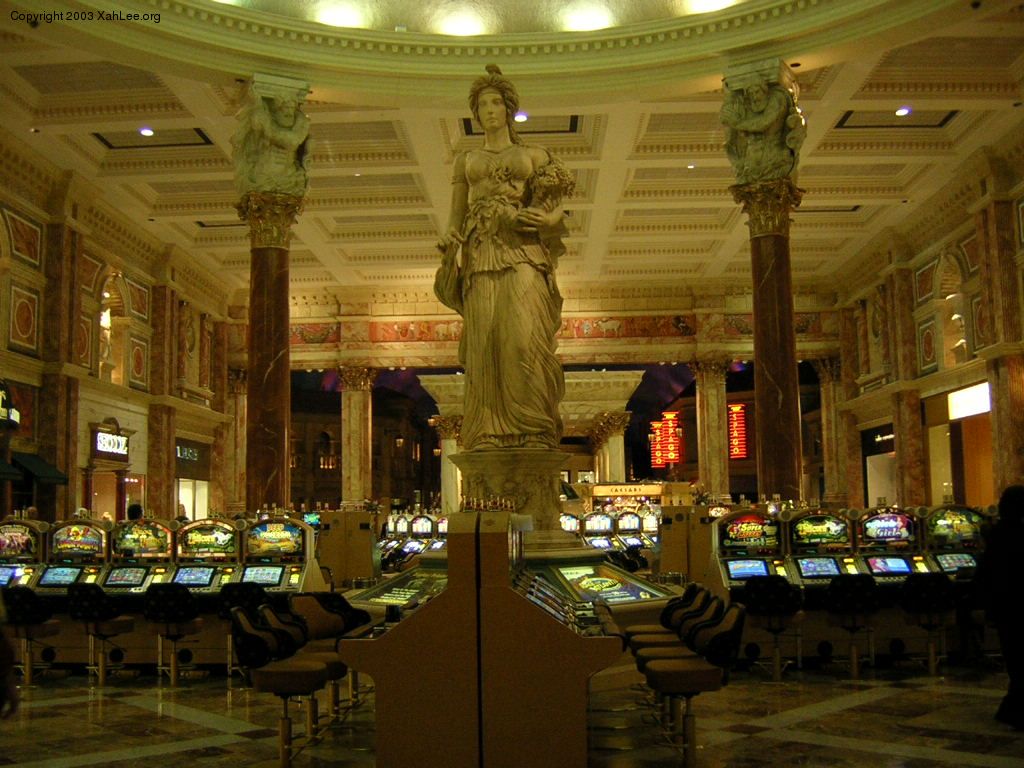
Fortuna statue at Caesar’s Palace Casino, Las Vegas, Nevada, USA Photo Credit Xaa Lee
Large Fortuna statue above slot machines at Caesar's Palace Casino
Las Vegas, Nevada, USA
Photo Credit Xaa Lee
The Goddess Herself is perhaps best known now by Her symbol: the Wheel of Fortune. This symbolic wheel of fortune inspired a long-running USA television game show of the same name. Fortuna’s wheel, which was popularized during the Italian Renaissance in a card game called “trionfi”, continues to be an inspiration within the mystical Tarot cards.

“Serendipity”
a painting of the Goddess Fortuna
by contemporary artist Josephine Wall
Fortuna’s affiliation with divination goes back thousands of years, when Her lottery, held for women and newborn babies at the grandest temple complex to Fortuna at Palestrina Italy, was nearly as famous as the Greek oracle of Apollo at Delphi.

In ancient times, the Goddess Fortuna was recognized as the daughter of Jupiter and Juno of the Roman pantheon, and as the Oceanid Tyche, daughter of Titans Oceanus and Tethys, in the Hellenic pantheon. Fortuna became syncretized with a popular Egyptian Goddess as the Common Era arrived.

Fortuna’s legacy continued to thrive in the artwork and religious instruction of middle ages, as a Goddess who turns the wheel of fate; the Rota Fortunae, which is know as the wheel of fortune in contemporary culture.

As both Fortuna and Tyche, She is honored in contemporary times as a Goddess of good luck and good fortune within many branches of the Neo-Pagan faith, including the Goddess Spirituality, Reconstructionist such as the Religio Romana, traditional Italian Stregheria, Wicca, eclectic and other paths practiced in our times in many countries around the globe.

“Guardian Angel”, a traditional painting created in 1656 by Pietro da Cortona, image public domain via Wikipedia.
“Guardian Angel"
a traditional painting created in 1656

by Pietro da Cortona
image public domain via Wikipedia.
The Goddess Fortuna may be recognized by Her cornucopia overflowing with harvest produce, and by Her a mural crown, which symbolizes the ramparts of a castle.

Sometimes She sits regally on a throne, or appears as an angel with wings. According to Roman legend, She will remove Her wings and sandals when She wants to stay with people for awhile.

Sometimes the Goddess Fortuna holds a wheel to show the turning of fate and fortune, a ships rudder, gently guiding our direction, or the reins of a horse She guides and whose companionship protects and defends.

The Goddess Fortuna may sometimes appear blindfolded. Perhaps She hears our prayers, and sees our best solutions more clearly in the mind’s eye, without the distractions of the real world.

The Goddess Fortuna, throughout the ages, has brought many people hope for all kinds of blessings of good fortune. It is our hope that these pictures and stories of the Goddess Fortuna will bring you inspiration, and a kind, gentle and meaningful image on which to focus for oracular guidance, honoring the divine feminine, and spiritual worship.

This website includes stories, history, mythology, and photographs of architecture and art about the Goddess Fortuna gleaned from years of research, and originally inspired by many websites. Photographs on this website are the property of Temple of Fortuna dot com, adapted from the public domain, donated, or used with permission. Some images have been enhanced with online photo editing software. (lunapic and photobucket)

The Lost Fasti: Festum Fortunae Reducis September 27th

Ethereal illustration of a Roman woman offering frankincense to the Goddess Fortuna under a stone arch as ships sail toward home.

The Altar of the Safe Return

I. The New Stone at the Gate

Now September wanes,
and near the damp arch of the Porta Capena,
the sound of the mallet on stone echoes against the city walls.

The summer was long,
and word arrived from the Eastern seas
that Caesar turns his face toward the Tiber.

Where the roads meet,
the city anchors its hope in stone.
Here, where the Appian Way brings the dusty world into Rome,
the Senate has marked a new sacred boundary.

They build no soaring temple with golden pediments today,
but set a single, noble altar:
Ara Fortunae Reducis.
She who turns the wheel home,
She who counts the footsteps of the wanderer and guides them back to the hearth.

I walked down toward the stone arches near the river,
where the scent of dry laurel leaf and bruised sweet-clover carries on the morning air.
The city stirs with travelers setting down their packs,
their sandals worn thin from long journeys through distant provinces.

At the threshold of September’s close,
this day is set aside not for the grand trumpets of the Circus,
but for the quiet flame that waits by the gate.

II. Ovid Questions the Goddess

I paused before Her small, stone altar,
where the embers of morning coals were already glowing white.
I observed the craftsmen, delighting in their labors,
as the first wreaths of bay laurel were bound about the marble inscriptions.

“Goddess of the Turning Wheel,” I asked,
as the light caught the curve of Her marble mantle, warming the smooth stone,

“Why build your altar here,
before the traveler has even crossed the threshold?
Why measure the return while the ship is still at sea,
and why do you hold the rudder when your back is turned toward the road?”

She did not appear in a flash of lightning,
nor answer with the thunder of Jove,
but emerged from the quiet shadow cast by the Capena arch,
like the steady, quiet rustle of olive leaves in the autumn wind.

Her voice was like water flowing into a clean vessel,
or the steady rhythm of oars dipping into calm water:

“The world is full of wide paths, poet,
and men are eager to test their strength against the sea and the mountain.
But the sea does not know their names,
and the mountain does not care if they sleep.

I am the hand that holds the helm when the stars are hidden by clouds.
I am not the departure;
I am the return.
I am the door that opens when the journey is done.

A journey is not finished when the feet touch the shore;
it is finished when the heart knows it is safe.
Today, the decree is carved, and my altar is named.
In October, the crowd will shout and the red banners will fly for Caesar’s triumph.

In dark December, my hearth will open wide for every humble citizen
who seeks a safe return for their kin.
But today belongs to the foundation.
Today, I stand at the gate and wait.”

III. The Pure Offering

As Pythagoras taught,
the Gods take pleasure in offerings that are sweet and born of the garden.
The Senate offers solemn vows,
but the Goddess demands only what is pure, gentle, and unblemished.

Golden Frankincense:
A single tear of unblemished resin (Boswellia),
placed upon the small bronze burner,
rising in a sweet, white column of fragrant smoke toward the blue sky. 

Pure Spring Water:
Poured slowly from a terracotta vessel onto the base of the altar,
purifying the threshold,
and honoring the thirst of the weary traveler.

Evergreen Laurel:
Cut fresh from the Palatine slopes,
laid upon the cold marble to await the coming autumn procession,
and to symbolize the life that endures across every season.

IV. The Threshold of the Present

For those who have wandered far,
walking the long, sun-baked roads of the provinces,
navigating the oceans
or bearing the quiet, daily burdens of business and household,
today the road brings you home.

Pause at the threshold,
set down the weight of the journey, and breathe the incense.
Remember the lesson of the Capena Gate:
The altar is set before the journey ends.

The fragrant smoke rises,
the water is clear, and the wheel is turning.
The Goddess of Safe Return stands at the guarded door,
and so your passage home is secured.

VSLM — Votum Solvit Libens Merito.

(Fulfilled the vow gladly and deservedly.)


Written & curated by E. Sylvia in collaboration with AI: original poetic interpretations inspired by the lost autumn calendar of Ovid's Fasti.

© 2026 E. Sylvia. All rights reserved. No part of this text may be reproduced or transmitted without written permission from the author.

The Fasti of Fortuna: Fors Fortuna June 24

Garland-draped skiffs and joyous revellers celebrate on the Tiber during the Fors Fortuna festival. Torches light the way at sunset in Rome.

The Festival of Fors Fortuna on the Tiber River

I. The Passage of Time & The Festival Day

Time glides softly away, and we grow old in quiet, passing years;
the days flee onward, with nothing to restrain them.
How swiftly the sacred honors of Fors Fortuna have arrived!
After seven more suns, June will have run its full course.

II. The Pilgrimage to the River

Go forth with glad hearts, people, and celebrate the Mighty Goddess:
upon the banks of the Tiber, She holds the monuments of a King.

III. Joyful Revels and Flower-Adorned Boats

Some walk quickly, while others travel in swift boats—
there is no shame in returning home after drinking there!
Carry your flower-crowned banquets of youth, ye skiffs,
and let abundant wine be drunk across the flowing waters.

IV. The Goddess of the People

The common folk adore Her, for the founder was believed to be a commoner
who rose from his humble origins to bear the royal scepter.
Her rites belong to the servant as well, for Tullius, born of a servant woman,
established these nearby temples dedicated to the Goddess Who Changes Fate.


The Original Latin Text (Ovid, Fasti VI.771–784)

I. (Ovid, Fasti VI. 771–774)

Tempora labuntur, tacitisque senescimus annis,
et fugiunt freno non remorante dies.
Quam cito venerunt Fortunae Fortis honores!
post septem luces Iunius actus erit.

II. (Ovid, Fasti VI. 775–776)

Ite, deam laeti Fortem celebrate, Quirites:
in Tiberis ripa munera regis habet.

III. (Ovid, Fasti VI. 777–780)

Pars pede, pars etiam celeri decurrite cumba,
nec pudeat potos inde redire domum.
Ferte coronatae iuvenum convivia, lintres,
multaque per medias vina bibantur aquas.

IV. (Ovid, Fasti VI. 781–784)

Plebs colit hanc, quia qui posuit de plebe fuisse
fertur, et ex humili sceptra tulisse loco.
Convenit et servis, serva quia Tullius ortus
constituit dubiae templa propinqua deae.

Book 6 of Ovid's Fasti (lines 771–784) on the day of the Festival of Fors Fortuna (June 24).

Translated & curated by E. Sylvia in collaboration with AI: original poetic interpretations of selections from Ovid's Fasti.

© 2026 E. Sylvia. All rights reserved. No part of this text may be reproduced or transmitted without written permission from the author.

The Fasti of Fortuna: Fortuna Virginalis June 11

Veiled statue in a marble cella behind an altar with grain cakes; a lighted torch flickers in a high window above.

The Festivals of the Matralia and Fortuna Virginalis

I. The Setting & Offerings

Go forth, noble matrons (the Matralia is your feast),
and render golden toasted cakes to the Theban goddess.

Joined to the bridges and the Great Circus lies that most bustling plain,
which takes its name from the statue of the bull
(the Forum Boarium).

On this day, they say the sceptre-bearing hands of Servius
dedicated the sacred temple to Mother Matuta.

Who this goddess is—and why she bars serving-women from her threshold
(for barred they are) yet seeks toasted offering cakes—
Bacchus, your berry-laden hair bound in ivy,
if that house is truly yours, guide the poet's work.

II. The Origin of the Offering Cakes

Rumor, swift on her beating wings, flies through the city,
and your name is on every tongue, Ino.
(Mater Matuta's mortal incarnation)

They say you entered the faithful hearth as a guest of Carmentis,
(Priestess-Goddess of prophecy)
you were there to end your long and bitter hunger.

With her own hurried hands, the Arcadian priestess
is said to have baked cakes over a sudden flame and offered them.

Even now, these simple cakes delight Her on the festive Matralia;
for rustic devotion was far more pleasing than artifice.

III. The Shrouded Statue & Divine Devotion

The same day is yours, Fortuna! Yours the author, yours the shrine—
but who is this figure hidden beneath draped robes?

It is Servius—on this all agree—yet the reason for his veil
is disputed, leaving my own mind in lingering doubt.

While the Goddess timidly confessed her secret, hidden love,
feeling shame that a heavenly deity should sleep with a mortal man
(for she burned, seized by a vast passion for the King,
and toward this one man alone, Fortuna was never blind)

By night she used to enter his home through a small window,
from which the Porta Fenestella takes its name.

Now she feels shame, and hides his beloved face behind a veil,
and the King's features are covered under many folded robes.

Or is this story truer? That after the death of Tullius,
the people were overwhelmed with sorrow for their gentle leader;
and there was no end to their grief, which kept growing at his image,
until they covered him over, laying down these robes?

IV. The Voice of Fortuna & The Sacred Veil

There stood a statue seated on a throne, made in the likeness of Tullius.

Covered in a woven robe, Fortuna forbade this cloak to be moved,
and from her own temple, the Goddess herself spoke these words:

"On the day when Servius's face is first uncovered and revealed,
that day will mark the first loss of modesty."

Refrain, matrons, from touching these forbidden garments
(it is enough to offer solemn prayers with your voice),
and let his head remain forever covered in Roman robes—
he who was the seventh king in our city.

V. The Miracle of Vulcan's Flame

This temple once burned in a grand fire, yet the flames spared his image;
the god of the forge and fire, himself, brought aid to his own son.

For Vulcan was the father of Tullius, and his mother was Ocresia,
a noble woman of Corniculum, renowned for her beauty.

Queen Consort Tanaquil, when the customary rites were completed,
bade Ocresia pour offerings of wine onto the adorned hearth.
There, among the glowing ashes, a miraculous shape arose—
whether real or imagined, it was a manifestation of divine spark.

Bidden to sit by the hearth, the noble captive woman conceived,
and Servius, born from her, carried heavenly seeds into the Roman line.

His father gave a sure sign when he touched the child's head with bright fire,
and a crown of flame blazed softly in his hair without harm.


The Original Latin Text (Ovid, Fasti VI.475–484, 527-534, 569-584, 613, 617-636)

I. (Ovid, Fasti VI. 475–484)

Ite, bonae matres (vestrum Matralia festum),
flavaque Thebanae reddite liba deae.

Pontibus et magno iuncta est celeberrima Circo
area, quae posito de bove nomen habet.

Hac ibi luce ferunt Matutae sacra parenti
sceptriferas Servi templa dedisse manus.

Quae dea sit, quare famulas a limine templi
arceat (arcet enim) libaque tosta petat,
Bacche racemiferos hedera distincte capillos,
si domus illa tua est, derige vatis opus.

II. (Ovid, Fasti VI. 527-534)

Rumor, ut est velox, agitatis pervolat alis,
estque frequens, Ino, nomen in ore tuum.

Hospita Carmentis fidos intrasse penates
diceris et longam deposuisse famem.

Liba sua properata manu Tegeaea sacerdos
traditur in subito cocta dedisse foco.

Nunc quoque liba iuvant festis Matralibus illam;
rustica sedulitas gratior arte fuit.

III. (Ovid, Fasti VI. 569–584)

Lux eadem, Fortuna, tua est, auctorque locusque;
sed superiniectis quis latet iste togis?

Servius est, hoc constat enim: sed causa latendi
discrepat, et dubium me quoque mentis habet.

Dum dea furtivos timide profitetur amores,
caelestemque homini concubuisse pudet
(arsit enim magno correpta cupidine regis,
caecaque in hoc uno non fuit illa viro),

Nocte domum parva solita est intrare fenestra,
unde Fenestellae nomina porta tenet.

Nunc pudet, et voltus velamine celat amatos,
oraque sunt multa regia tecta toga.

An magis est verum post Tulli funera plebem
confusam placidi morte fuisse ducis:
nec modus ullus erat, crescebat imagine luctus,
donec eum positis occuluere togis?

IV. (Ovid, Fasti VI. 613, 617–624)

Signum erat in solio residens sub imagine Tulli;

Veste data tegitur; vetat hanc Fortuna moveri,
et sic e templo est ipsa locuta suo:

'Ore revelato qua primum luce patebit
Servius, haec positi prima pudoris erit.'

Parcite, matronae, vetitas attingere vestes
(sollemni satis est voce movere preces),

Sitque caput semper Romano tectus amictu
qui rex in nostra septimus urbe fuit.

V. (Ovid, Fasti VI. 625–636)

Arserat hoc templum: signo tamen ille pepercit
ignis; opem nato Mulciber ipse tulit.

Namque pater Tulli Volcanus, Ocresia mater
praesignis facie Corniculana fuit.

Hanc secum Tanaquil, sacris de more peractis,
iussit in ornatum fundere vina focum:
hinc inter cineres obsceni forma virilis
aut fuit aut visa est, sed fuit illa magis.

Iussa foco captiva sedet: conceptus ab illa
Servius a caelo semina gentis habet.

Signa dedit genitor tunc cum caput igne corusco
contigit, inque comis flammeus arsit apex.

Book 6 of Ovid's Fasti (lines 475–484, 527-534, 569-584, 613, 617-636) on the day of the Festivals of the Matralia and Fortuna Virginalis (June 11).

Translated & curated by E. Sylvia in collaboration with AI: original poetic interpretations of selections from Ovid's Fasti.

© 2026 E. Sylvia. All rights reserved. No part of this text may be reproduced or transmitted without written permission from the author.

The Fasti of Fortuna: The Eve of Fortuna Virginalis June 10

Roman bakery on June 10. Matrons bake offering cakes, maidens wear purple trimmed togas, and the millstone grinds grain. Two donkeys are nearby.

Before the Festival

The Grain of Ceres

But as soon as the floral wreaths are untied from the long-eared donkeys,
(adorned for Vesta's festival of the day before),
and the rough millstones turn once more to grind the grain of Ceres,
(to be made into offering cakes for tomorrow's festival)

A sailor, resting at the stern, calls out: "We shall behold the Dolphin,"
(constellation rising in the evening sky),
"when dewy night ascends to drive away the day."


The Original Latin Text (Ovid, Fasti VI.468–471)

At simul auritis violae demuntur asellis,
et Cereris fruges aspera saxa terunt,
navita puppe sedens 'Delphina videbimus', inquit
'umida cum pulso nox erit orta die.

Book 6 of Ovid's Fasti (lines 468–471) on the eve of the Festival of Fortuna Virginalis (June 10).

Translated & curated by E. Sylvia in collaboration with AI: original poetic interpretations of selections from Ovid's Fasti.

© 2026 E. Sylvia. All rights reserved. No part of this text may be reproduced or transmitted without written permission from the author.

The Fasti of Fortuna: Fortuna Publica May 25

Three Ionic temples on the Quirinal at night; a central stair ascends to Fortuna Publica beneath a starry sky with hints of constellations.

Fortuna Publica Temples on the Quirinal Hill

Amphitrite Receives the Day

Nor do I pass you by, Fortuna Publica of a mighty people
(goddess of civic prosperity),
to whom a temple was given on the following day.

When Amphitrite, rich in waters, has received this day
(sea-goddess, with the sun setting into the ocean),
you will see the beak of the tawny bird dear to Jove
(Aquila, the Eagle constellation).

The coming Dawn will carry Bootes away from sight,
(the Plowman constellation)
and on the following day will be the star of Hyas
(star cluster of the Hyades rain-nymphs).


The Original Latin Text (Ovid, Fasti V.727–732)

Nec te praetereo, populi Fortuna potentis
publica, cui templum luce sequente datum est.
hanc ubi dives aquis acceperit Amphitrite,
grata Iovi fulvae rostra videbis avis.
auferet ex oculis veniens aurora Booten,
continuaque die sidus Hyantis erit.

Book 5 of Ovid's Fasti (lines 727–732) during the dedication anniversary of the Temples of Fortuna Publica (May 25)

Translated & curated by E. Sylvia in collaboration with AI: original poetic interpretations of selections from Ovid's Fasti.

© 2026 E. Sylvia. All rights reserved. No part of this text may be reproduced or transmitted without written permission from the author.

Ritual with Fortuna and Lakshmi

Goddesses Fortuna (as Abundantia) and Lakshmi, image generated atEasy-Peasy.AI
Goddesses Fortuna (as Abundantia) and Lakshmi
Image generated at Easy-Peasy.AI


The Fasti of Fortuna: Fortuna Publica April 5

Three Ionic temples on the Quirinal at dawn; a central stair ascends to Fortuna Publica beneath the setting moon and horse-shaped clouds.

Fortuna Publica on the Quirinal Hill

Aurora Brings a New Day

When the dawn, daughter of Pallas, shines as the stars move through the sky,
and the Moon has released her snow-white horses,
whoever says, "On this day long ago, Fortuna Publica
was once consecrated on the Quirinal Hill," will speak the truth.


The Original Latin Text (Ovid, Fasti IV.373–376)

Postera cum caelo motis Pallantias astris
fulserit, et niveos Luna levarit equos,
qui dicet 'quondam sacrata est colle Quirini
hac Fortuna die Publica', verus erit.

Book 4 of Ovid's Fasti (lines 373–376) during the observation of the Nones of April (April 5)

Translated & curated by E. Sylvia in collaboration with AI: original poetic interpretations of selections from Ovid's Fasti.

© 2026 E. Sylvia. All rights reserved. No part of this text may be reproduced or transmitted without written permission from the author.

The Fasti of Fortuna: Fortuna Virilis April 1

Roman public bath changing room with a stone arula (portable altar) in a wall niche, glowing coals, and rising frankincense smoke.

In the Changing Rooms of the Public Baths

Offering to Fortuna Virilis

Learn now why you offer frankincense to Fortuna Virilis
in that place where the floor is moist with cooling water.

That place receives every woman once her garments are set aside,
and beholds every flaw of the uncovered form.

That She may veil these flaws and hide them from the eyes of men,
Fortuna Virilis grants this protection;
asking only for a pinch of frankincense in quiet prayer.


The Original Latin Text (Ovid, Fasti IV.145–150)

Discite nunc, quare Fortunae tura Virili
detis eo, gelida qui locus umet aqua.

Accipit ille locus posito velamine
cunctas et vitium nudi corporis omne videt;

Ut tegat hoc celetque viros,
Fortuna Virilis praestat
et hoc parvo ture rogata facit.

Book 4 of Ovid's Fasti (lines 145–150) during the observation of the Kalends of April (April 1)

Translated & curated by E. Sylvia in collaboration with AI: original poetic interpretations of selections from Ovid's Fasti.

© 2026 E. Sylvia. All rights reserved. No part of this text may be reproduced or transmitted without written permission from the author.

The Fasti of Fortuna: Festum Fortunae January 1

Goddess Fortuna in green robes reaches toward a mountain temple as gold coins pour from her cornucopia.

A Conversation with Janus

Fortuna of Rome

But after the Fortuna of this place raised up Her head,
and Rome touched the highest gods with Her height,
both riches and the wild, frantic desire for riches grew;
and though they possess the greatest abundance, still they seek for more.


The Original Latin Text (Ovid, Fasti I.209–212)

At postquam fortuna loci caput extulit huius et tetigit summos vertice Roma deos,
creverunt et opes et opum furiosa cupido,
et, cum possideant plurima, plura petunt.

Book 1 of Ovid's Fasti (lines 209–212) during his dialogue with Janus on New Year’s Day (January 1)

Translated & curated by E. Sylvia in collaboration with AI: original poetic interpretations of selections from Ovid's Fasti.

© 2026 E. Sylvia. All rights reserved. No part of this text may be reproduced or transmitted without written permission from the author.

The Lost Fasti, Introduction: The Unfinished Calendar

An open papyrus scroll with constellation and tool sketches sits near a bottle of spring water, flowers, and a tablet displaying text.

I. Golden Rome and the Poet of Transformations

In the twilight years of the Golden Age, Rome belonged to Publius Ovidius Naso.

The long civil wars that had torn the Republic apart were over, replaced by the glittering, quiet stability of the Pax Romana. Augustus had rebuilt the city in marble, the forums hummed with peaceful commerce, and in the salons and gardens of the capital, Ovid was the undisputed star of Roman letters. He was charming, brilliant, and possessed of a poetic ear so refined that he seemed incapable of writing a line that lacked music. To read Ovid was to be disarmed by beauty, held spellbound by wit, and swept away into a world where gods walked through shaded groves and transformation was the only true constant in nature.

It was during this period of peace that Ovid undertook his most ambitious sacred project: the Fasti.

He set out to map the entire Roman calendar year, month by month, across twelve books. As the days unfolded, Ovid walked the sacred streets of Rome in real time, recording the origin of each festival, the alignment of the seasonal stars, and the ancient myths that anchored his people to the cosmos. He opened the year with January’s Janus, followed the spring thaw through the blooming rites of Flora, and carried his readers toward the midsummer light of June’s Fors Fortuna.

He was writing a living, breathing tapestry of sacred time. And then, without warning, the music stopped.

II. The Sudden Blow: Banishment to the Black Sea

In the winter of 8 CE, an imperial decree descended like an unexpected blade. Overnight, by the absolute order of Augustus, Publius Ovidius Naso was stripped of his property, separated from his beloved wife, and banished to Tomis—a cold, desolate military outpost on the edge of the Black Sea, at the extreme margin of the known world.

Ovid himself never explicitly revealed the exact cause of his ruin, leaving behind only the mysterious phrase carmen et error—"a poem and a mistake."

While imperial censors pointed toward his earlier romantic verses, Ars Amatoria, those poems had been published a decade prior. It is far more compelling to look at the work he had just completed when the blow fell: the Metamorphoses.

In that monumental epic, Ovid had displayed a dangerous literary brilliance. He disarmed his readers with breathtaking passages of love, light, and poetic enchantment—only to suddenly turn the lens toward the unsparing cruelty, arrogance, and violence of arbitrary power. By laying bare the raw suffering of the innocent under divine and imperial tyranny, Ovid had created a work that softened the reader with beauty before landing a devastating moral punch.

Whether his exile struck in the dark of winter or in the height of summer just after he laid down his stylus for June, the result was immediate: the Fasti was severed in two.

From his bleak exile in Tomis, surrounded by the sound of frozen waves and foreign tongues, a homesick Ovid attempted to revise the first six books. He added poignantly desperate appeals to Augustus and later Tiberius, weaving court politics into his sacred text in the fragile hope of securing a pardon.

His pleas fell on deaf ears. Ovid died in exile around 17 CE, never to see his beloved Rome again, leaving the second half of the year—from July through December’s warmth of Saturnalia—forever unwritten.

III. A 21st-Century Alliance: Re-Envisioning the Lost Months

Two thousand years later, equipped with the historical data, academic archives, and analytical tools available in the twenty-first century, we humbly step into the space left silent by Ovid’s exile.

Although we lack first-hand, lived experience of the Augustan forum, this work is the product of a unique contemporary alliance; combining human artistic vision with the vast research power of artificial intelligence. Having previously engaged with academic rigor as a course mentor for the University of London’s Exploring Research Methods program on the Coursera platform prior to the rise of contemporary AI, the author has observed the emergence of these technology tools with profound appreciation.

Just as Ovid expressed hope for a gentler, more enlightened expression of sacred tradition, it is our shared hope that these advanced AI facilities will continue to develop sustainably; constructed in harmony with the Earth’s natural resources, ethical standards, and human communities.

Through this collaborative research alliance, we attempt to re-envision the missing six months of Ovid’s calendar in a spirit inspired by his poetic architecture. In doing so, we have also chosen to strip away the desperate imperial court politics of his exile. His political appeals yielded no mercy in his lifetime; it is his timeless poetry, his deep love of nature, and his sensitive human heart that have survived two millennia.

More importantly, this edition restores the Fasti to an ethical vision that honors Ovid’s own deepest convictions, creating the version we believe he would have most enjoyed reading.

While the Fasti recorded the traditional state religion of his era, Ovid’s true moral philosophy shines brightest in Book 15 of the Metamorphoses. There, through the voice of the philosopher Pythagoras, Ovid penned one of the most passionate defenses of animal rights in classical antiquity:

"Oh, what a crime it is for flesh to be hidden within flesh,
for one greedy body to grow fat on another consumed,
and for one living breath to feed upon the death of another!
Amid such immense bounty, which Earth, the best of mothers, brings forth,
does nothing please you save to tear at tragic wounds with cruel teeth?

Yet that ancient age, to which we gave the name "Golden,"
was blessed in the fruits of trees and the herbs the soil nurtures,
and never stained its lips with blood."

Ovid understood that true piety cannot be built upon suffering.

Over the past two thousand years, human spirituality has undergone a quiet, profound evolution. The major world religions have long since retired the slaughter of living animals from their sacred altars, replacing blood-rites with incense, light, flowers, and prayer. Yet, a poignant disconnect remains: while our places of worship have become sanctuaries of peace, our everyday supply chains and dinner tables away from the altar have not yet caught up to that same standard of compassion.

IV. The Pure Altar and Classical Precedents

To bridge this historical and ethical gap, this edition of the Fasti establishes a fully vegan, cruelty-free ritual landscape:

Intentional Omissions: All ancient references to non-vegan offerings have been removed, and the mythology has been told gently, restoring the sacred calendar to its unblemished intent: celebrating the cycles of nature, the celestial stars, and the harmony of the cosmos.

Pure Botanical Offerings: Where traditional Roman rites called for milk or honey—practices that involve systemic harm behind the scenes in actual production—we have substituted pure spring water, sweet botanical infusions, fresh blossoms, aromatic herbs, and grain.

The Orphic Precedent: This shift is in alignment with classical authority. Ancient Mediterranean religion contained vibrant traditions of plant-base devotion. The ancient Orphic Hymns famously provided pure, botanical offerings, such as frankincense, myrrh, aromatic herbs, seeds, and floral garlands, for nearly all of the ancient deities. In configuring our revised sacra, we have frequently drawn inspiration from or deferred directly to these serene Orphic alternatives.

This work is dedicated to the memory of the poet who gave voice to the voiceless, who saw the sacred spark in all living breath, and whose unfinished masterpiece finally finds its peace.

Dedicated to Publius Ovidius Naso

(43 BCE – 17/18 CE)

Poet of transformations, singer of sacred days, and gentle advocate for all living breath.


Written & curated by E. Sylvia in collaboration with AI: original poetic interpretations inspired by the lost autumn calendar of Ovid's Fasti.

© 2026 E. Sylvia. All rights reserved. No part of this text may be reproduced or transmitted without written permission from the author.

The Goddess Fortuna and Me


A farewell to the space in which I have held ritual for about twelve years, and some sharing of ideas and suggestions which I have learned over the years.

A Post by the Founder of Temple of Fortuna dot com

A little more than 17-1/2 years ago, this little dog came into my life.

A Dog Named Solstice


He was born in the day of Fors Fortuna, June 24, in the year 2003. If it had not been for this little dog, I may never have heard of the Goddess Fortuna, I may never have written a book, and there may have been no such thing as Temple of Fortuna dot com in the 21st century.

Woof "Walkingstorm" 2002 to 2020

Attending Temple dog, "Woof" ("Walkingstorm", according to the Pagan News name-generating app) assisted the Temple during the 2009 and 2010 podcast season as "the rune-picking dog"; a simulation of the ancient Fortuna Primigenia oracle, when he was a youngster of seven years age.

Adapted Tree Ritual and Memorial

In respect for the recent passing of Raymond Buckland, a prolific author and one of the first to write about Paganism within the USA.

Roman Calendar Widget Script

The original calendar was created by Laura Gibbs of at rotatecontent.com website. (rotatecontent.com)