translate

Abbatia

Her Story

Roman replica of Greek Statue of the Fourth Century CE, from the New Wing Chiaromonte Museum of the Vatican Museums, Vatican City, Italy. Photo credit: Sailko
Roman replica of Greek Statue of the Fourth Century CE,
from the New Wing Chiaromonte Museum
of the Vatican Museums, Vatican City, Italy.
Photo credit: Sailko
The ancient Roman Goddess Fortuna has been a very well known and popular Goddess since at least 640 B.C.E.

The Goddess Fortuna has been an inspiration for women and children and a protectress for men, a provider of happiness and success in love, long-term relationships, career, and good health.

From Her ancient origins, She thrived throughout the Common Era and continues Her presence in contemporary culture.

As Rome expanded from a city to an empire throughout Italy, and into Europe, North Africa, the Middle East and Britain, so did Fortuna’s vast realm. She appears in architecture, artwork and inscriptions to the Goddess.

Many temples were dedicated to Goddess Fortuna in ancient times and she took on different roles depending on the type of assistance requested by the petitioner.

These roles are represented in names describing Her various aspects; many of which are found in ancient documents and inscriptions, and in the names of Her festivals.

The Roman festivals of the Goddess Fortuna, as they have been handed down through the ages, are shown on the Calendario (Calendar) page of this website.

The Goddess Fortuna also had regional celebrations. She was greatly honored as a protective Goddess at the fortified gates of cities throughout the ancient world.

Fortuna Statue for Worship in the Home.  Photo credit: image in the public domain  via Wikipedia
Fortuna Statue for Worship in the Home.
Photo credit: image in the public domain
via Wikipedia
Inscriptions to Fortuna Salutaris and Fortuna Balnearis grace health-bringing baths.

The holiday of Fortuna Redux celebrates the safe coming-home of loved ones from overseas.

Fortuna Virilis celebrations embody life-long love and attraction in marriage, and the oracle of Fortuna Primigenia is for newborn babies and mothers.

Fortuna Privata assists and protects personal life in the home.

The original strength of the Goddess Fortuna represented good fortune in the home and away from home, traditional family values, and equal opportunities for people from all walks of life.

The Goddess Fortuna, in any of Her aspects, may have been petitioned privately, silently or discreetly when there was a need or desire to honor the good fortune of the divine feminine.

Does anybody still believe in or pray to the Goddess Fortuna?


Surprisingly, the answer just might be Yes!

The Goddess Fortuna, who is also known as “Lady Luck”, may appear at any time in contemporary culture. Her immortal mystique graces several Las Vegas gaming casinos in the USA as an inspiration of good fortune and, perhaps, actual fortune for casino players and guests.
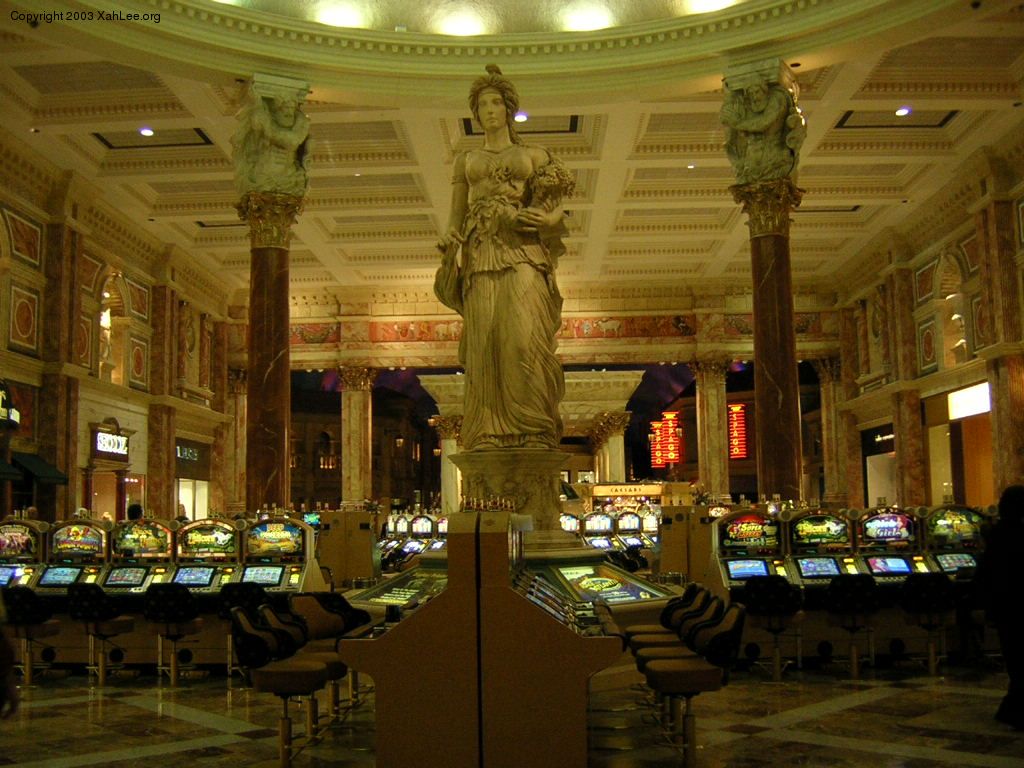
Fortuna statue at Caesar’s Palace Casino, Las Vegas, Nevada, USA Photo Credit Xaa Lee
Large Fortuna statue above slot machines at Caesar's Palace Casino
Las Vegas, Nevada, USA
Photo Credit Xaa Lee
The Goddess Herself is perhaps best known now by Her symbol: the Wheel of Fortune. This symbolic wheel of fortune inspired a long-running USA television game show of the same name. Fortuna’s wheel, which was popularized during the Italian Renaissance in a card game called “trionfi”, continues to be an inspiration within the mystical Tarot cards.

“Serendipity”
a painting of the Goddess Fortuna
by contemporary artist Josephine Wall
Fortuna’s affiliation with divination goes back thousands of years, when Her lottery, held for women and newborn babies at the grandest temple complex to Fortuna at Palestrina Italy, was nearly as famous as the Greek oracle of Apollo at Delphi.

In ancient times, the Goddess Fortuna was recognized as the daughter of Jupiter and Juno of the Roman pantheon, and as the Oceanid Tyche, daughter of Titans Oceanus and Tethys, in the Hellenic pantheon. Fortuna became syncretized with a popular Egyptian Goddess as the Common Era arrived.

Fortuna’s legacy continued to thrive in the artwork and religious instruction of middle ages, as a Goddess who turns the wheel of fate; the Rota Fortunae, which is know as the wheel of fortune in contemporary culture.

As both Fortuna and Tyche, She is honored in contemporary times as a Goddess of good luck and good fortune within many branches of the Neo-Pagan faith, including the Goddess Spirituality, Reconstructionist such as the Religio Romana, traditional Italian Stregheria, Wicca, eclectic and other paths practiced in our times in many countries around the globe.

“Guardian Angel”, a traditional painting created in 1656 by Pietro da Cortona, image public domain via Wikipedia.
“Guardian Angel"
a traditional painting created in 1656

by Pietro da Cortona
image public domain via Wikipedia.
The Goddess Fortuna may be recognized by Her cornucopia overflowing with harvest produce, and by Her a mural crown, which symbolizes the ramparts of a castle.

Sometimes She sits regally on a throne, or appears as an angel with wings. According to Roman legend, She will remove Her wings and sandals when She wants to stay with people for awhile.

Sometimes the Goddess Fortuna holds a wheel to show the turning of fate and fortune, a ships rudder, gently guiding our direction, or the reins of a horse She guides and whose companionship protects and defends.

The Goddess Fortuna may sometimes appear blindfolded. Perhaps She hears our prayers, and sees our best solutions more clearly in the mind’s eye, without the distractions of the real world.

The Goddess Fortuna, throughout the ages, has brought many people hope for all kinds of blessings of good fortune. It is our hope that these pictures and stories of the Goddess Fortuna will bring you inspiration, and a kind, gentle and meaningful image on which to focus for oracular guidance, honoring the divine feminine, and spiritual worship.

This website includes stories, history, mythology, and photographs of architecture and art about the Goddess Fortuna gleaned from years of research, and originally inspired by many websites. Photographs on this website are the property of Temple of Fortuna dot com, adapted from the public domain, donated, or used with permission. Some images have been enhanced with online photo editing software. (lunapic and photobucket)

2026 Fortuna Huiusque Diei

Fortuna Huiusce Diei — Narrative

Morning arrives quietly over the city.

Before the markets open, before the streets fill with carts and voices, a small temple door swings inward on bronze hinges. A faint light spills across the stone floor.

Within stands Fortuna Huiusce Diei—

Fortune of this day,

not tomorrow,

not destiny written in the stars.

Only the fragile moment now.

She does not spin the great wheel of empires here.

She does not weigh centuries or dynasties.

Instead, she holds something smaller.

A bowl of morning light.

Each dawn she lifts it and pours its contents into the world:

A meeting that happens by chance.

A door that opens instead of closing.

A breeze that cools a traveler’s face, moving through open space.

A thought that arrives at the exact moment it is needed.

None of these are grand miracles.

Yet each one shifts the path of the day.

Those who come to her temple bring simple offerings—flowers, a coin, a ribbon tied to the rail. They do not ask for wealth or victory.

They ask for today.

“Lady of the Present Hour,” they whisper,

“let this day bend gently.”

And the goddess smiles, because this is the only fortune she truly governs.

The fortune that appears in the turning of a single hour.

The fortune hidden in a small coincidence.

The fortune that reveals itself only after night falls and someone says:

“Strange… the day worked out better than I expected.”

Then Fortuna Huiusce Diei closes the temple doors.

The bowl is empty again.

Somewhere beyond the horizon, another dawn begins to fill it.

And within that day, something begins to move.


Session 1 — Story Sketch & Moodboard

One-Paragraph Synopsis (Core Myth meets Modern Arc)

On a day quietly set in motion by Fortuna as Fortuna Huiusce Diei, a young dog slips through an unexpected opening and runs into the city, carried by instinct, a rush of air, and the exhilaration of sudden freedom. Guided not by thought but by sensation—cool air, crossing pathways, the scent of food, the memory of a central room where everything once connected—he navigates an unfamiliar world that feels strangely known. As the day unfolds, small moments of chance and recognition shape his path, leading him not through logic but through embodied memory toward safety, connection, and the beginning of a new understanding of home.


Identify the Fortuna and Zodiac Sign

Fortuna Form: Fortuna Huiusce Diei (Fortune of This Day)

Zodiac Sign: Aries (initiation, instinct, forward motion, the first step)


Key Characters (1–3)

The Dog (“Night”)

The central perspective. Moves through the world by sensation, instinct, and recognition rather than thought.

The Absent/Underlying Human (Protagonist)

Not present in the moment, but felt through memory—through routines, spaces, and emotional imprint.

The White Dog (Vision / Future Reality) (optional early presence)

A fleeting glimpse—uncertain, possibly real, possibly symbolic—hinting at connection beyond the immediate journey.


Settings

Ancient (Mythic Layer):

The Temple of Fortuna Huiusce Diei at dawn

A quiet interior space where the day is “given” before it unfolds

Modern (Narrative Layer):

A city neighborhood with narrow passages, sidewalks, and small openings

Transitional spaces: alleyways, shaded gaps, thresholds between inside and outside

A sheltered spot that echoes the central crossroads room of the house


Central Image / Symbolic Object

The Crosscurrent of Air

Not a physical object, but a felt condition:

air moving from multiple directions

a place of intersection

a moment where the body recognizes safety

This mirrors:

the central room of the house

the crossroads of the day

Aries as the point of movement

As a physical object, an optional secondary symbol could be:

✨An open doorway or gap in a wall — the moment opportunity appears


Visual / Musical Atmosphere

Visual Tone:

Early morning light shifting into full daylight

Warm sun contrasted with cool shaded spaces

Soft gold, pale stone, muted city tones

Movement of light across surfaces (walls, pavement, interiors)

Occasional flashes of white (the white dog, light, reflection)

Spatial Feeling:

Open → narrow → open again

Movement through thresholds

Air in motion (subtle but constant)


Musical Tone:

Light rhythmic pulse (matching movement / paws / heartbeat)

Minimal instrumentation at first

Gradual layering as the dog explores

Natural sounds integrated:

footsteps

distant voices

wind

subtle city ambience

Emotionally:

curious

alert

alive

not anxious—energized


Optional Moodboard / Image Direction (for AI generation)

A small dog mid-motion in a sunlit urban passage

Light cutting across a narrow shaded corridor

Slight blur of movement (to capture Aries energy)

A second, faint white figure in the distance (ambiguous presence)

Emphasis on airflow and openness rather than crowding


Closing Note for This Session

This session is not about explaining the day.

It’s about entering it.

Fortuna sets the condition

Aries initiates movement

The dog follows what feels right

Everything else unfolds from that.